
NOW YOU HAVE 30 SECONDS
Marketing Video for VirtuSense Technologies
- Project Goal: Create an evergreen marketing piece that was memorable, sharable, and clearly explains the product’s function to the target market.
- Role(s): Technical Director, Camera Operator, Video Editor, VFX Artist
- Date Released: September 17th, 2020
- Results: Video was shared out on several marketing email lists, and ended up landing the biggest lead to date for the company; it continues to be a successful go-to video to share out as a hook for marketing drips and sales conversations.
Project Breakdown
Script and Brainstorming
The script was penned by the talented Jared De Roo, who directed the project and played on screen as the “Hip Tech Guy Narrator” in the video. It doesn’t matter how much work you put into the production, without a good script to start with, your video will not work. They say genius is 1% inspiration and 99% perspiration, and while that was definitely true in this case, turns out that small 1% greatly effects the quality of the final product.
#occupycreativity: 1% of the creative process effects 99% of the end product
After the script was done, we got our team together and got to brainstorming. Our marketing team, which at that time consisted of Jared, myself, and Madison Schwindenhammer, our graphic designer, went through the script and threw every crazy idea we had against the wall. Some of them were terrible, and many of them ended up being too complicated, too infeasible, or just too expensive. But a good portion of them stuck.
Having a good creative team that’s willing to throw out any crazy idea without fear of judgement is imperative for quality content creation, and for a quirky project like this, it would’ve been impossible without it.
Planning and Logistics
Once we had a good sense of what we wanted to do visually, we moved on to the planning of the shoot. Pre-production is the least flashy part of a video production, which makes it easy to overlook, but in my experience, it’s the single most important step. In all the video projects I’ve done over the years, there hasn’t been a single one where I can look back and say: “Yeah, we didn’t have to spend so much effort on preproduction.”
“Yeah, we didn’t have to spend so much effort on preproduction.”
~Nobody ever
With a video like this, with so many pieces and moving parts, planning was of the utmost importance. We had to make a list of all the actors, props, costumes, and equipment we needed. We had to work out a budget based on those needs. We had to figure out a shoot date. Because we were mostly using coworkers as actors, we had to make sure everyone’s schedule lined up and was blocked out for the shoot date. We had to book our location.
Making sure everyone has their own tasks that they’re in charge is key in production of this magnitude. Even though we only had three people planning out the project, everyone had their own jobs that they were in charge of and everyone had very specific responsibilities.
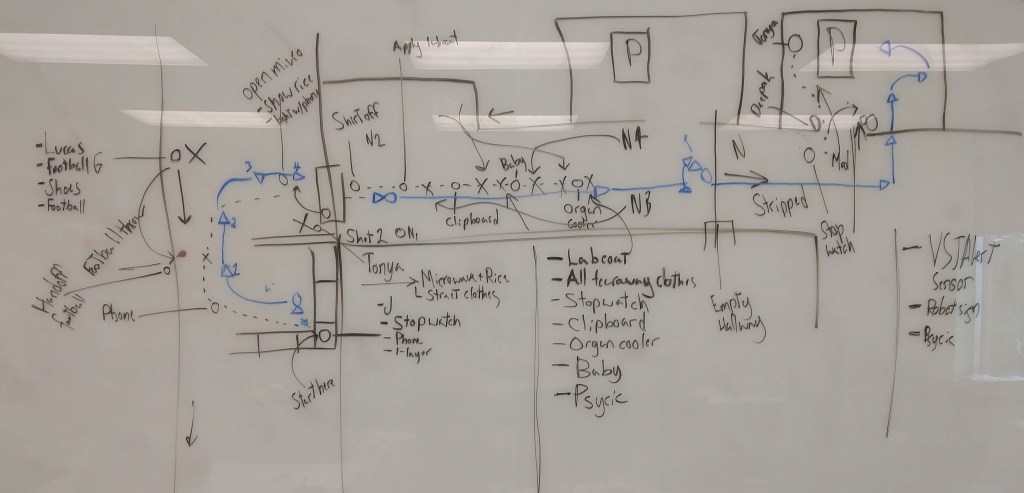
Another aspect of this video was the choreography. In the second shot, we had a bunch of nurses milling about with six different prop handoffs, and that had be blocked out and timed to match the script and the location we were filming at.
Because we had good access to the location we were filming at, we were able to go out and film a previsualization to make sure everything lined up the way we wanted it to. This ended up being key in finalizing the choreography.
This previsualization also gave light to another problem, that was specifically my responsibility to find a solution to: The lighting. While the on-location light wasn’t terrible, it was lacking a polished feel, especially in the hallway, where between the ceiling panels there would be moments of extreme shadow for our talent.
We certainly didn’t have the budget to redo the lights on the location, so the solution would have to be simple and achievable with a small crew. I found a potential solution with the gear we had in house, and we able to test it back at the office- and it worked!
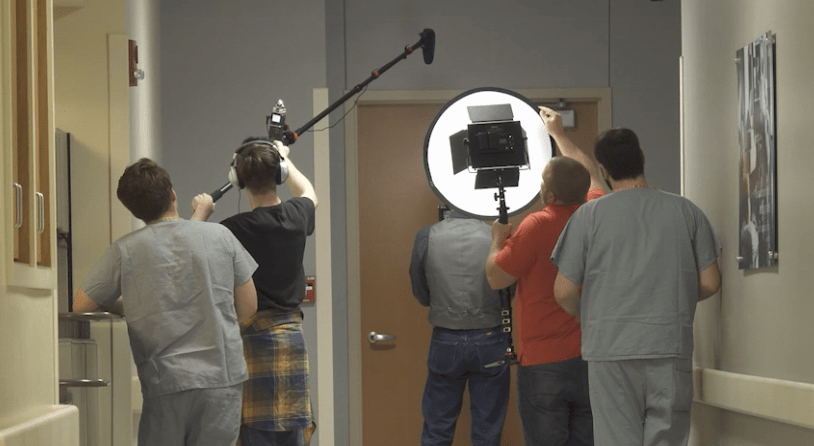
I used a small LED panel mounted to a monopod, with a small popup diffusion in front. This ensured the talent would always have at least some separation from background, would avoid heavy shadowing on his face, and would always have a bit of a catch light in the eyes, which is the secret sauce in making the lighting for a corporate video look intentional and add life to your talent’s eyes. Of course, this meant we had to track down one more crew member to help out on set, but the difference in the final product was definitely worth it.
The week before the shoot, we had to double check and finalize everything: Do we have all the props and costumes? Check. Do we have all the equipment we need? Check. Are all our actors and crew still good to go? Uh oh, two of our nurses had things pop up. That means we have to update the choreography in order to make all the handoffs work in shot two. This means having nurses double back along the hallway in order to have some actors fill up two roles.
Finally, we worked out a master chart with a floor plan, all the choreography, the props, and the actors, to make sure nothing was amiss. Were we ready for shoot day? It sure felt like it, but there was only one way to find out…
Production
All the shooting was done on one day. We had the location booked from 10AM to 4PM, which is a small window considering the scale of what we were trying to accomplish. We shot in chronological order of the three shots.
For those that care about gear, I’ll get all that out of the way: This was shot on a Sony A7III using a Tamron 28-75mm F/2.8 lens zoomed all the way out to 28mm. The stabilizer was a DJI Ronin-SC, the light was a Neewer Bicolor LED panel, and the sound was recorded through a Rode Video-mic pro+ recording into a Zoom H5.
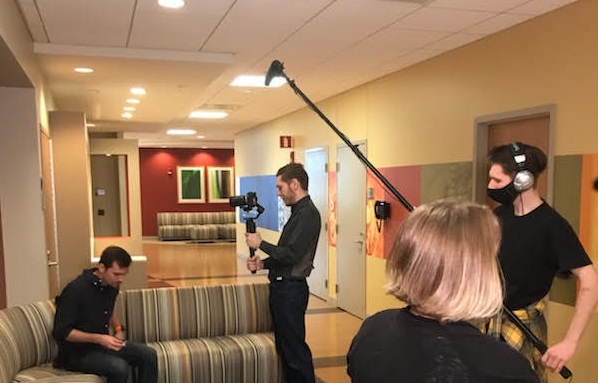
The first shot went off without a hitch, with a little bit of work to get the camerawork just right. This shot was simpler, so we had extra time to fiddle with the camera settings and the performance. After we got everything we needed, we got some wild lines for the football player and Foley from onset of footsteps and the football.
Then was shot two, the complicated one. Not only was it the longest, clocking in at about 20 seconds of the video compared to the other 2 shots sticking at about 15, it also had the most moving pieces, with handoffs, nurses running back and forth, and two sets of tearaway clothes, and all of this working around the camera, boom, and light operator, but it also had a somewhat time-consuming reset- every time we got another take, we had to reset the tearaway clothes, which meant a lot of waiting around on set in between takes.
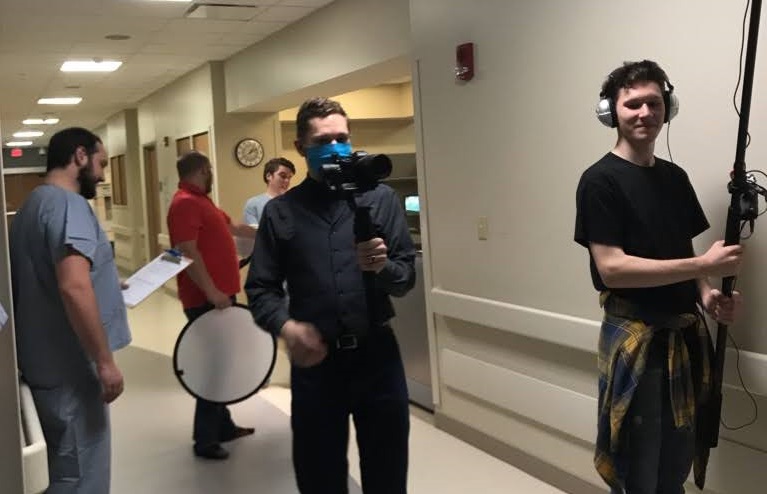
In the end though, this shot went much smoother than it had any right to go. We got plenty of usable takes and ended up with multiple options in post. We aimed for a minimum of 3 solid takes for each shot, but after we got these, we got one more safety take. I’ve never regretted getting a safety take. In two out of the three shots for this video, we ended up using the last take we got in the final cut.
I think there’s something about shooting one more take when everyone knows we have what we need, and everyone knows that we’re almost done with the shot that brings out a slightly more relaxed and smooth performance.
Editing
Editing the footage itself wasn’t too difficult- once we chose the takes, it was just a matter of finetuning the specific cuts. The big deals here were sound design and the various effects and graphics. There are a total of 9 VFX “shots” in this 3-shot video. Here’s a quick breakdown of them and my favorite aspects of each one:
- Countdown timer: Simple tracking and text animation here. My favorite thing that nobody will notice is that the face of the digital stopwatch was also added in post.
- The Tweet: The likes, comments, and retweets are individually animated to be numerically climbing. What can I say, I have a gift for hashtags.
- Microwave flash: This was the only effect that was not part of the original plan for the video, otherwise, we might have had a practical light on set. My favorite detail nobody will notice is the shadow it casts on the wall. It’s the little things.
- Psychic: I just love this effect and this part of the video. That is all.
- Logo removal: There was logo I had to remove from the sign next to the door. You can see it pop back into the existence in the far distance later.
- Second stopwatch shot: Again, the watch face is added in post.
- Transition between shots 2 and 3: A fun little slide to keep the momentum of the video. Shooting in 4K and delivering in 1080p allowed me a lot of freedom for re-cropping for this effect.
- VSTAlert graphic: This one is pretty simple, but fun. Tracked the circle to the sensor in the hand.
- Blink: The less obvious and final VFX shot in the video is completely invisible if you don’t know it’s there. This was our favorite take of the shot, but it just had one problem: Deepak, our founder and Chief Technology officer, looked at the camera for a split second. Not a deal breaker, but a little distracting. Because he blinks right after, I was able to basically extend the blink to a second before, and voila, distraction gone.
That’s the breakdown of the process creating this video. It was a lot of teamwork and a lot of logistics, but it’s still one of my favorite videos I’ve ever made.
Extra little bits of trivia for those that read until the end:
- We got over 70 takes between the three shots.
- Despite having throws and catches in two of the shots, the closest we came to having something dropped was a messed-up football handoff.
- Everyone that was walking that could take off their shoes did. The floors, especially in the second and third shot, were quite loud and squeaky.

 Tobias Lansberry